

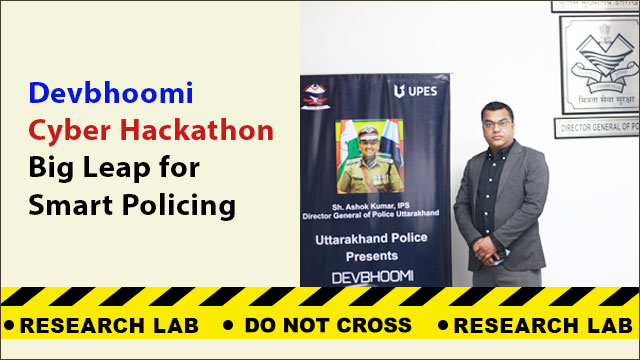
The Devbhoomi Cyber Hackathon 2021 was the first cyber hackathon organized by Uttarakhand Police in partnership with UPES. Held from 10–12 November 2021 in Dehradun, the 36-hour coding marathon drew 326 teams from across India to build solutions for smart policing and cybercrime detection. Saumya Srivastava and Kartik Setia (Jain University) won first place.
What Was the Devbhoomi Cyber Hackathon?
The Devbhoomi Cyber Hackathon was a state-level initiative by Uttarakhand Police to address the growing threat of cybercrime by harnessing the problem-solving capabilities of young technologists. The name “Devbhoomi” — meaning “Land of the Gods” — reflects Uttarakhand’s identity while symbolizing the state’s forward-looking approach to digital policing.
The event was supported by the School of Computer Science at the University of Petroleum and Energy Studies (UPES), Dehradun, and was designed to align technology innovation with law enforcement requirements across the state.
Why Did Uttarakhand Police Organize a Cyber Hackathon?
Cybercrime in India has grown significantly with increased digital adoption. Uttarakhand, like other Indian states, has seen a rise in online fraud, phishing attacks, and social engineering scams targeting citizens across age groups. Traditional policing approaches are insufficient to address threats that originate in digital spaces.
Cyber hackathons address this gap by bringing fresh technical minds together to design tools, systems, and methodologies that law enforcement can deploy. The Devbhoomi Hackathon specifically focused on smart policing — using technology-driven solutions to make cybercrime investigation faster and more effective.
Understanding the structure of cyber crime investigation units helps appreciate why field-ready tools developed through hackathons are so valuable to frontline officers.
How Was the Hackathon Structured?
Prelim Round (Online)
Participating teams submitted abstracts of their proposed solutions addressing specific problem statements. The submission deadline was 24 October 2021. Teams whose abstracts were shortlisted by the jury advanced to the final round.
Final Round (Offline — 36-Hour Coding Marathon)
The final hackathon was a 36-hour continuous coding session held at UPES, Dehradun from 10–12 November 2021. Teams built and demonstrated working prototypes of their solutions. The jury evaluated submissions on technical soundness, real-world applicability to policing, and innovation.
Who Were the Winners of the Devbhoomi Cyber Hackathon?
Results were announced on 31 October, the birth anniversary of Sardar Vallabhbhai Patel (National Unity Day). The Director-General of Police (DGP) of Uttarakhand, Sh. Ashok Kumar, personally honored the winners.
| Position | Winner(s) | Institution | Prize |
|---|---|---|---|
| Winner | Saumya Srivastava & Kartik Setia | Jain University | ₹50,000 |
| First Runner-Up | Sanyam Jain & Manjot Singh | Lovely Professional University | ₹30,000 |
| Second Runner-Up | Meet Bisht | Parul University | — |
| Consolation | Shivankar Kumar Singh | Aginity Communications Pvt. Ltd. | — |
| Consolation | Arya Kesharwani, Abhinav Singh, Sachin Singh, Akshay Srivastava & Abhinav Singh | IIT Madras | — |
How Many Teams Participated and Where Did They Come From?
A total of 326 teams registered for the Devbhoomi Cyber Hackathon — a substantial number for a state-level inaugural event. Participants came not only from Uttarakhand but also from Tamil Nadu, Maharashtra, Gujarat, Karnataka, Punjab, and Delhi, reflecting the pan-India appeal of the initiative.
This diversity of participation demonstrated that cyber challenges affecting one state resonate with technologists nationwide, and that smart policing solutions require diverse technical perspectives.
What Role Did Cyber Experts Play in the Hackathon?
The event featured contributions from cyber domain experts who evaluated solutions and guided participants. As a cyber expert in India, participating in events like the Devbhoomi Hackathon is part of building an ecosystem where law enforcement and technology professionals work together to address the most pressing challenges in digital policing.
Jury evaluations focused on whether the proposed tools were practically deployable by police officers without deep technical backgrounds — a critical criterion for real-world adoption.
Why Do Cyber Hackathons Matter for Law Enforcement?
Cyber hackathons serve multiple purposes for law enforcement agencies:
- Tool development: Prototypes created during hackathons can be developed into production tools used by investigators.
- Talent identification: Police departments can identify and recruit technically skilled individuals who understand cyber investigation workflows.
- Awareness creation: Participants learn about real cybercrime challenges, making them more cyber-aware professionals and citizens.
- Community engagement: Hackathons build bridges between law enforcement and academia, fostering long-term collaboration.
Equipping investigators with the right tools begins with understanding what a cyber forensics lab setup requires — and hackathon solutions often feed directly into lab capabilities.
What Comes After a Cyber Hackathon?
Winning solutions from the Devbhoomi Cyber Hackathon were presented to Uttarakhand Police leadership for evaluation and potential integration into smart policing workflows. The hackathon is intended to be a recurring initiative, with the goal of making Uttarakhand a model state for technology-led policing in India.
For citizens who encounter cybercrime, knowing where to report is equally important. The National Cyber Crime Helpline 1930 remains the first point of contact for reporting digital fraud in India.
